The Biggest Indie Hit of 2026 Launched at 74.9% Positive
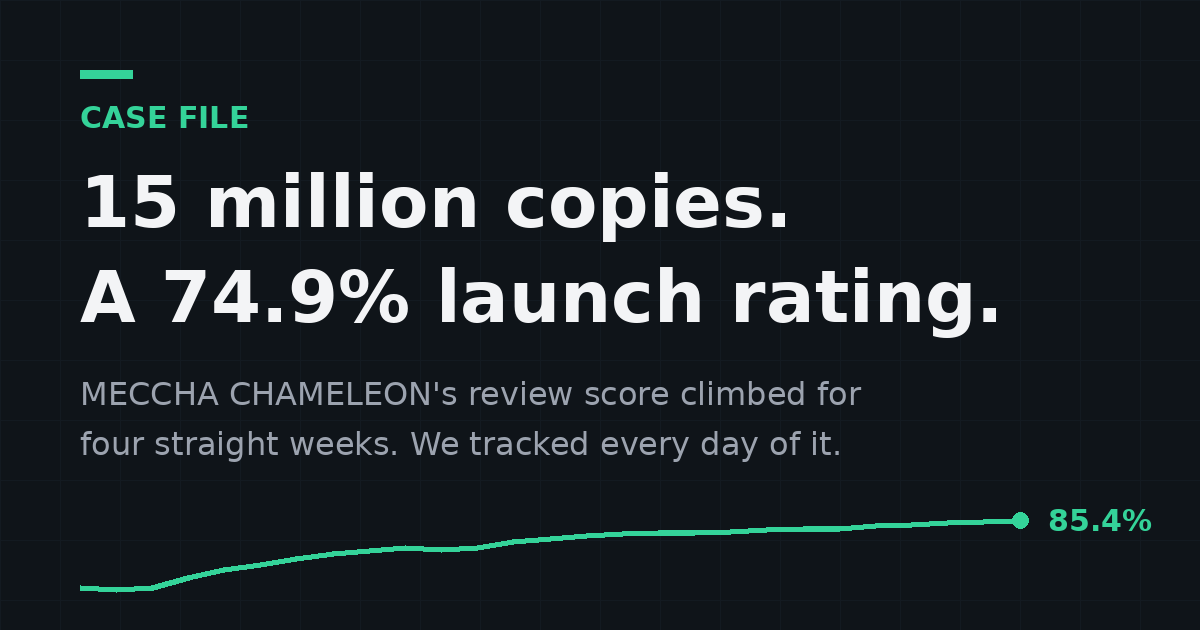
On June 10, 2026, MECCHA CHAMELEON launched on Steam with a 74.9% positive rating — ten points short of "Very Positive," within sight of "Mixed." Twenty-seven days later it had reportedly sold 15 million copies, and its rating stood at 85.36%.
Most games spend their launch month watching the score erode. The biggest indie hit of the year spent it climbing, almost every single day. We snapshotted all twenty-seven of them.
What the data shows
MECCHA CHAMELEON is a two-person hide-and-seek game in which players paint their own bodies to blend into the scenery. Developer LEMORION announced 15 million copies sold on July 5, as reported by Game*Spark — a figure so fresh that third-party trackers hadn't caught up to it (VG Insights showed roughly 9 million at the time). At $5.99, even the conservative count implies tens of millions of dollars in under a month.
The sales story has been widely covered. The review story hasn't, because it only exists in daily deltas.
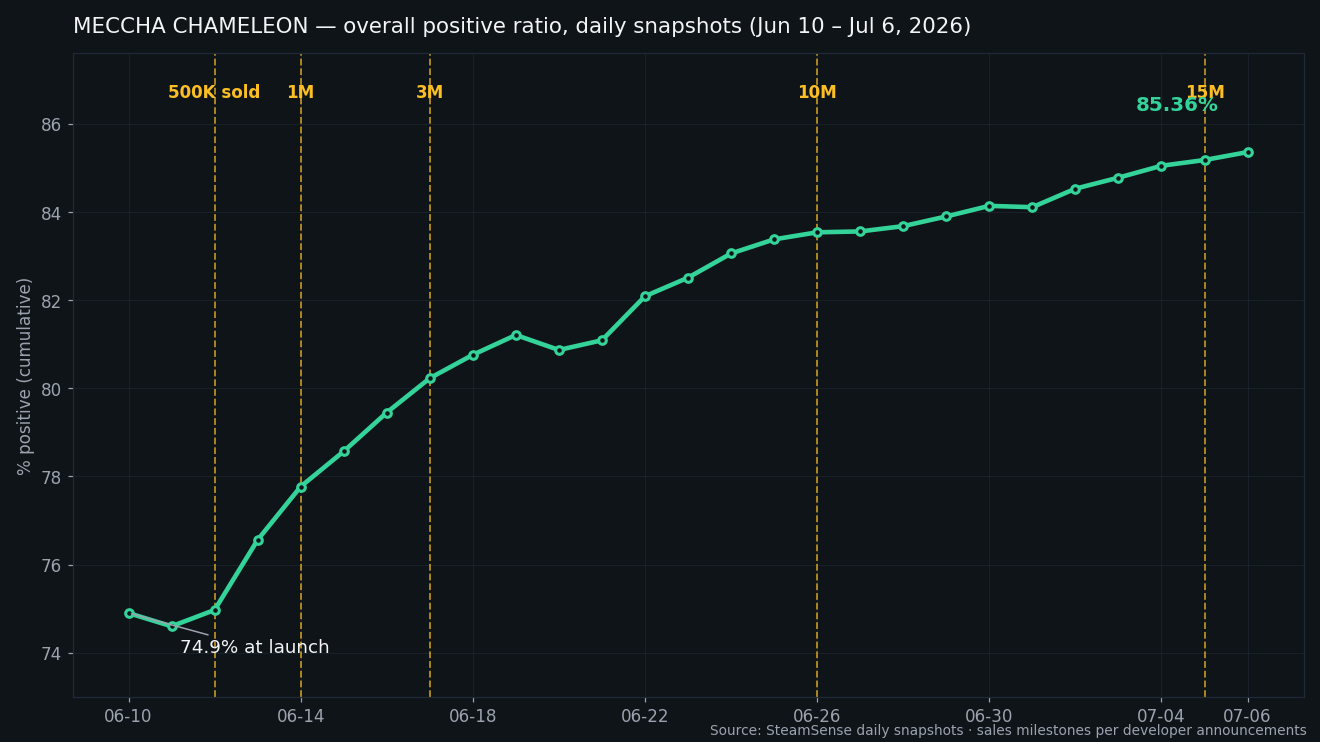
Three things stand out in that curve.
The launch score was mediocre. 74.9% on day one, and it actually dipped to 74.6% on day two — the game's low point. The timing is easy to read: a two-person team's netcode meeting a player flood no one had planned for (in interviews, the developers describe multiplayer paint-syncing as the hardest technical problem of the project). If you had judged the game by its store page that week, you'd have seen a middling party game.
Then it climbed on 23 of the next 25 days. From 74.6% to 85.36%, a rise of 10.8 points, with only two barely-visible down days in between (−0.34pp on June 20, −0.03pp on July 1). Cumulative ratings are heavy — every new day's reviews get averaged against everything that came before — so a sustained climb like this requires the incoming reviews to run dramatically more positive than the existing pool, week after week. The new players arriving by word of mouth were consistently happier than the launch crowd.
The score crossed Steam's "Very Positive" threshold (80%) on June 17 — the same day the developer announced 3 million copies sold. The rating and the sales curve fed each other: better score, better conversion; more happy players, better score.
The cooling has started
The second chart is the one to watch from here.
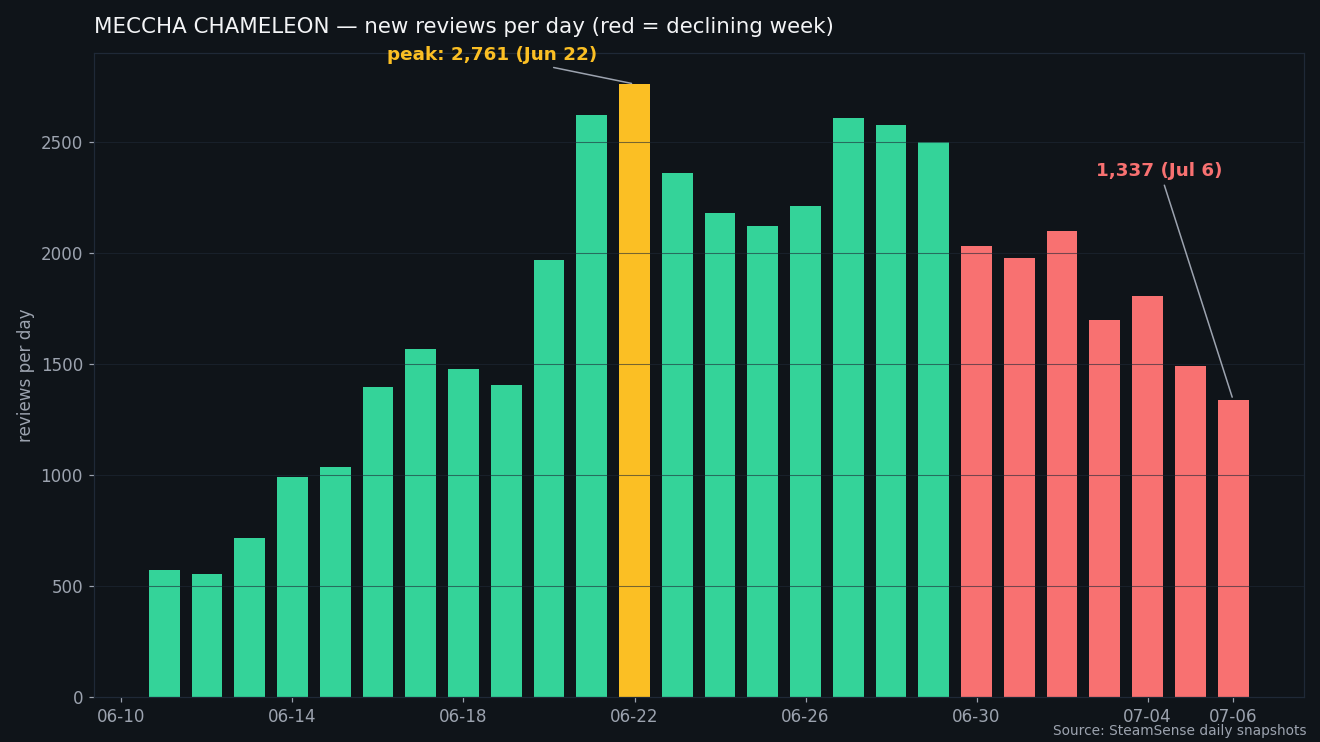
Daily review intake peaked at 2,761 on June 22, held a high plateau through June 29, and has declined in almost every session since — down to 1,337 on July 6, roughly half the peak. Our anomaly system is flagging a "Review Volume Drop" signal on the game as of today.
None of this is alarming in itself; every viral game cools. But Japanese press coverage has already asked the obvious question — whether a hide-and-seek game whose maps can be memorized will hold its audience. The velocity curve is where that answer will appear first, weeks before it shows in the score. We'll keep the snapshots running.
The silent fifteen million
Here is the number that we find strangest: 15 million reported sales, 46,781 reviews. That's a review rate of about 0.3% — roughly one review per 320 buyers.
Steam games typically collect one review per 30–80 sales; that ratio is the basis of the widely used Boxleiter method for estimating sales from review counts. MECCHA CHAMELEON sits an order of magnitude outside that band. Apply a normal ratio to its review count and you'd estimate 1.5–3.5 million sales — nowhere near 15 million.
There are a few non-exclusive explanations. The buyer base skews casual and party-oriented (per developer interviews, the largest player regions are the United States and China), and casual buyers review far less than core Steam users. The $5.99 price lowers the emotional stakes — people review $60 disappointments more readily than $6 diversions. And it's possible the announced figure counts something broader than individual Steam purchases. We can't distinguish these from the outside; we can only say the gap is real and unusually large.
It's the mirror image of a case we flagged in this week's Review Watch: TBH: Task Bar Hero, which pairs an enormous concurrent-player count with a tiny review count — because idle bots don't write reviews. MECCHA CHAMELEON pairs enormous sales with few reviews — because silent casual buyers don't either. Review counts measure engaged humans, and engaged humans are a small, skewed sample of any player base. Whenever a game's headline number (players online, copies sold) and its review count tell wildly different stories, the gap itself is usually the most informative data point on the page.
Why it matters
For developers, the launch-week lesson is the useful one: a mediocre day-one score is not a verdict. MECCHA CHAMELEON opened at 74.9% with server problems and climbed 10 points on the strength of the players who came after the fixes. The direction of the daily ratio — not its level — was the honest signal of the game's health, and that direction is invisible on the store page. A 75% game trending up and a 75% game trending down look identical on Steam; they are opposite situations.
For anyone reading sales headlines: check the review count next to them. It won't tell you the sales figure is wrong, but it will tell you what kind of audience is actually in the building.
A note on method
The numbers in this article come from daily snapshots of MECCHA CHAMELEON's public Steam review totals (count, positive/negative split, score category), taken at 03:00 UTC from June 10 through July 6, 2026, as part of SteamSense's tracking pool of 29,950 games. Sales milestones are the developer's own announcements as reported by GameSpark and other outlets; we can't verify them independently, and we note that VG Insights' model showed a materially lower figure. Development details come from LEMORION's interviews with Denfaminicogamer, GameWith and GameSpark. Review-to-sales benchmarks reference the Boxleiter method's commonly cited 30–80x range. Full methodology: How we track Steam reviews.
FAQ
What is MECCHA CHAMELEON's Steam rating? As of July 6, 2026: 85.36% positive across 46,781 reviews — "Very Positive." It launched at 74.9% on June 10.
How many copies has MECCHA CHAMELEON sold? The developer announced 15 million copies on July 5, 2026, per Game*Spark. Third-party estimates (VG Insights) trailed at roughly 9 million at that date.
Why does MECCHA CHAMELEON have so few reviews for its sales? About 0.3% of reported buyers have reviewed it, versus a typical 1–3% on Steam. Likely factors: a casual, party-skewing audience, the low price point, and possibly a broad definition in the announced sales figure.
Data: SteamSense daily snapshots, June 10 – July 6, 2026. Track the live curve at steamsense.app/game/4704690.