Why Do Steam Review Counts Go Down?
On May 8, 2026, Slay the Spire 2's Steam review count fell by 3,589 in a single day. No announcement, no notification, no public log — 3,589 reviews simply weren't there anymore. Over the following three weeks the game lost another 7,000, and its review score went up.
If you've ever looked at a game's review count and found it lower than you remembered, you weren't imagining it. Steam review totals go down all the time. This page explains how that happens, what it looks like in data, and why disappearing reviews often raise scores rather than lower them.
The short answer
Steam never publishes deletion events. But when you record every game's review totals daily — which is what we do — removals show up as simple arithmetic: today's count minus yesterday's, negative. There are four main ways a review leaves the platform.
Cause 1: Players delete their own reviews
Any Steam user can edit or delete their review at any time, and there's no time limit. People withdraw reviews after a patch fixes their complaint, after cooling off from a review bomb they joined, or simply while tidying their profile. Self-deletion is the steady background drip: a handful of reviews per day for most large games, usually invisible unless you're subtracting daily totals.
Cause 2: Valve moderation
Reviews that violate Steam's rules — spam, hate speech, scams, copy-paste flooding — get removed by Valve. Developers can also flag reviews they believe break the rules; Valve decides whether the flag is upheld. Moderation removals cluster around drama: when a game goes through a review bomb, the cleanup that follows tends to arrive in visible waves rather than a drip.
Cause 3: Off-topic review purges
Since 2019, Valve has run an "off-topic review activity" system. When it detects a coordinated surge of reviews about something other than the game itself (a developer controversy, a pricing decision elsewhere, politics), it marks the period and excludes those reviews from the score by default. Officially this is exclusion rather than deletion — but in the cases we've tracked, the game's public review counts also fell during and after the flagged window, which means at least part of the flagged volume is effectively removed from the totals, not just hidden from the score.
Cause 4: Account-level removals
When Valve bans accounts — bot farms, compromised accounts, spam rings — content posted by those accounts can go with them. A ban wave against a botting operation can erase that operation's reviews overnight. Purchases revoked after chargebacks similarly take their reviews out of the pool. Individually small, these removals become noticeable on games with large bot economies.
What it looks like in the data
From the outside, all four causes produce the same signature — a day-over-day decrease — and cannot be told apart. That matters: anyone claiming to know which mechanism removed reviews from a game is guessing, us included. What the data does show precisely is the size, timing and composition of removals.
Composition is where it gets interesting. In the Slay the Spire 2 cleanup, we could measure which side of the ledger the vanished reviews came from: across 23 days, negative reviews disappeared at 2.12 times the rate of positive ones (6,087 negatives vs 4,722 positives). The game's score rose from 62.15% to 63.55% without any surge of new praise — the critics were simply leaving the dataset faster than the fans. The full case study is here: How Slay the Spire 2 Recovered by Losing 10,809 Reviews.
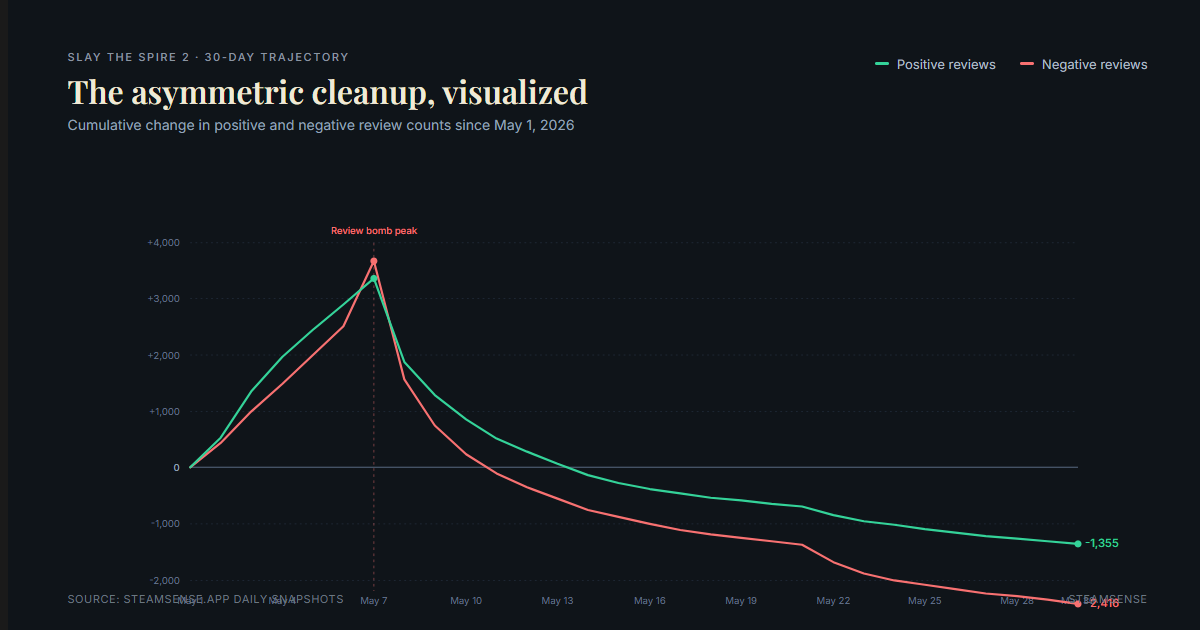
That asymmetry generalizes, and it makes sense once you think about what gets removed: review-bomb waves are overwhelmingly negative, so moderation and off-topic purges eat into the negative pile; regretted reviews that players self-delete after a fix are negative by construction. The practical consequence is counterintuitive — a game losing reviews is often a game whose score is recovering.
How often does this happen at scale? Less often than you might think. Large removal events are episodic, tied to specific dramas — in our first weekly Review Watch, covering 29,950 tracked games, not a single game lost more than a handful of reviews all week. The background drip is constant; the cliffs are rare and newsworthy.
How to check a game yourself
Steam's store page won't show you any of this — it only displays the current state. To see whether a game has lost reviews, you need its history: look the game up on steamsense.app, where the daily review-count series makes any decrease visible, or compare archived store-page snapshots if you enjoy doing things the hard way. For games we track, decreases also surface automatically in our weekly Vanishing Reviews section.
FAQ
Can Steam reviews be deleted? Yes, three ways: the reviewer can delete their own review at any time, Valve moderation can remove rule-breaking reviews (including ones flagged by developers), and account bans or revoked purchases can take reviews with them. Off-topic purges can also remove flagged review waves from the totals.
Why did a game's review count drop overnight? A large single-day drop almost always follows a review-bomb episode — Valve's moderation and off-topic systems removing flagged waves in bulk, sometimes thousands in a day. The biggest single-day drop we've recorded is 3,589 reviews (Slay the Spire 2, May 8, 2026).
Does Valve remove negative reviews to protect games? Removals do skew negative — but not because Valve protects scores. Negative reviews dominate rule-breaking waves (bombs, spam, off-topic pile-ons), so cleanups mechanically remove more negatives than positives. The result can look like score protection: in cases we've measured, scores rose during mass removals.
Do refunds delete reviews? A refund alone doesn't delete a review — Steam marks the reviewer as a refunder but keeps the review. Reviews disappear when the purchase itself is revoked (e.g., chargebacks) or the account is banned.
Data: SteamSense daily snapshots of 29,950 games. Methodology: How we track Steam reviews. Check any game's review history at steamsense.app.