A $1.49 Price Tag Gave a 12-Year-Old Game Its Biggest Month Ever
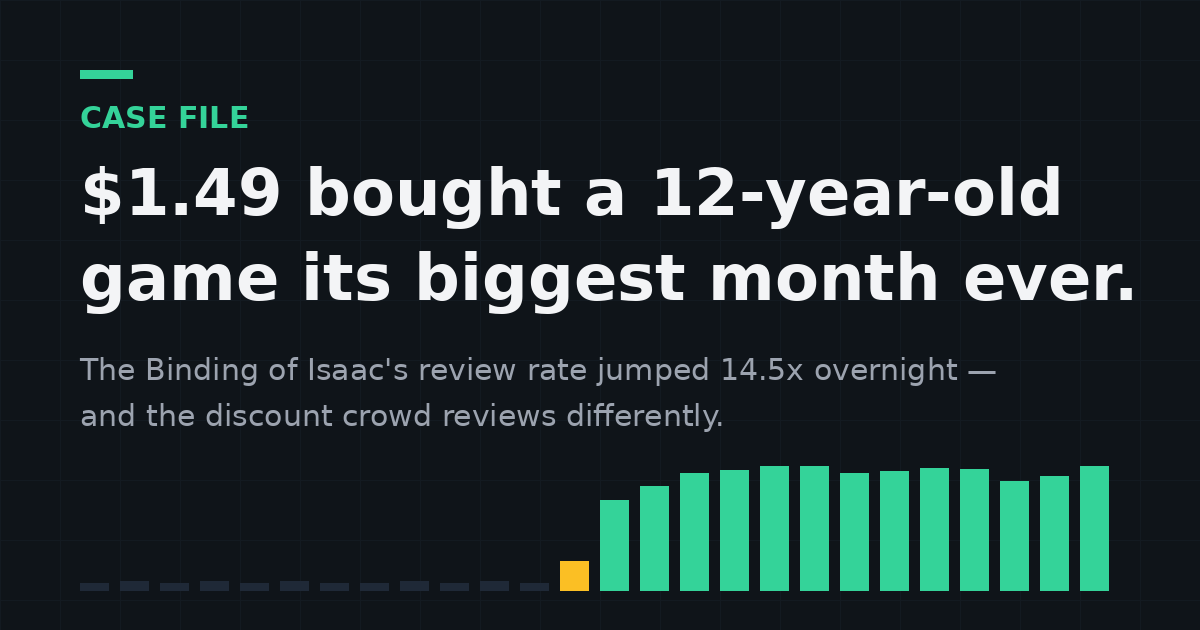
For the first three weeks of June, The Binding of Isaac: Rebirth — a roguelike released in 2014 — collected new Steam reviews at a rate of about 102 per day. The pace barely moved: 77 on the slowest day, 120 on the busiest. It was the steady heartbeat of a beloved back-catalog game in its twelfth year.
Then, on June 25 at 10am Pacific, the Steam Summer Sale opened, and Isaac's price dropped 90% to $1.49 — its steepest discount ever. The next morning's snapshot caught the first ten hours of it: +374 reviews. The day after: +1,139. By the end of the week the game was collecting reviews at 14.5 times its June baseline, and it did not slow down for two straight weeks.
On July 3 it hit 147,401 concurrent players — an all-time peak, twelve years after release, roughly double the previous record set when the Repentance expansion launched in 2021, as PC Gamer reported. The player-count story has been covered widely. The review data tells two quieter stories that haven't been.
Story one: the surge that refused to decay
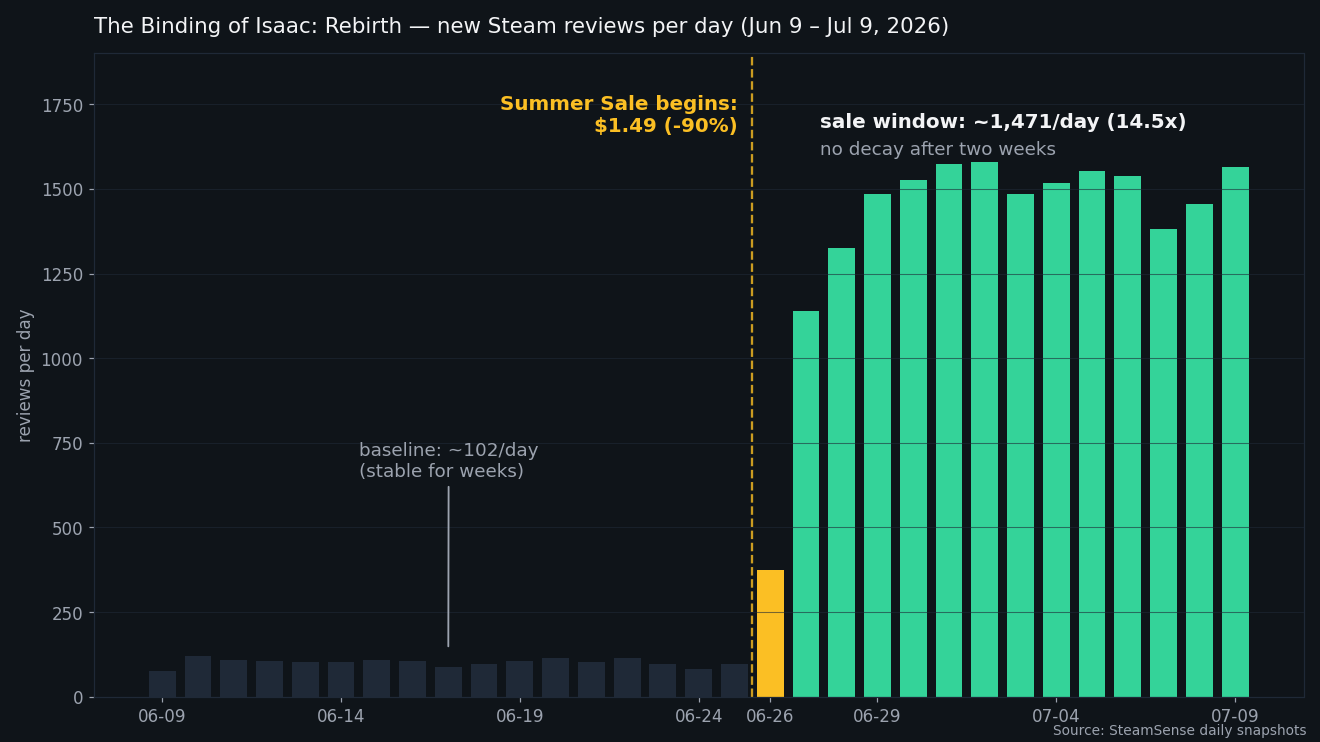
Viral surges decay. We measured exactly that pattern in MECCHA CHAMELEON's launch, where daily review intake peaked twelve days in and then slid week after week. Isaac's sale surge doesn't look like that at all: from June 27 through July 9 the daily count oscillated in a tight band around 1,471 — the last day of the window (+1,565) was as strong as the first.
The likeliest reading is mundane and, we think, more interesting for it: this isn't virality, it's price elasticity. A $1.49 tag on one of the most acclaimed games in its genre converts a steady stream of fence-sitters for exactly as long as the tag lasts. The Summer Sale ends today, July 9, at 10am Pacific. If the elasticity reading is right, the review rate should fall off a cliff within days — we'll publish the after-chart in next week's Review Watch.
One methodological confession while we're here: our own anomaly detector currently scores Isaac at zero, because after two weeks of 1,500-review days, the surge is the new 7-day baseline. Z-score detectors are built to catch spikes, and they normalize to plateaus. It's a known blind spot in our scoring — sustained regime changes stop looking anomalous — and this game is currently its best illustration.
Story two: the $1.49 crowd reviews differently
Isaac's overall rating barely moved during the sale — 97.23% positive on June 25, 97.09% on July 9. A rounding error, at a glance.
But a cumulative ratio is a heavy object. 359,810 reviews existed before the sale; moving the overall number down 0.14 points in two weeks takes a meaningfully different incoming cohort. Because we snapshot both totals and positive counts daily, we can compute what actually arrived: of the 19,492 reviews added between June 25 and July 9, roughly 18,420 were positive — a cohort positive rate of 94.5% (94.3–94.7% allowing for rounding in the published ratios), against the 97.2% of everyone who came before.
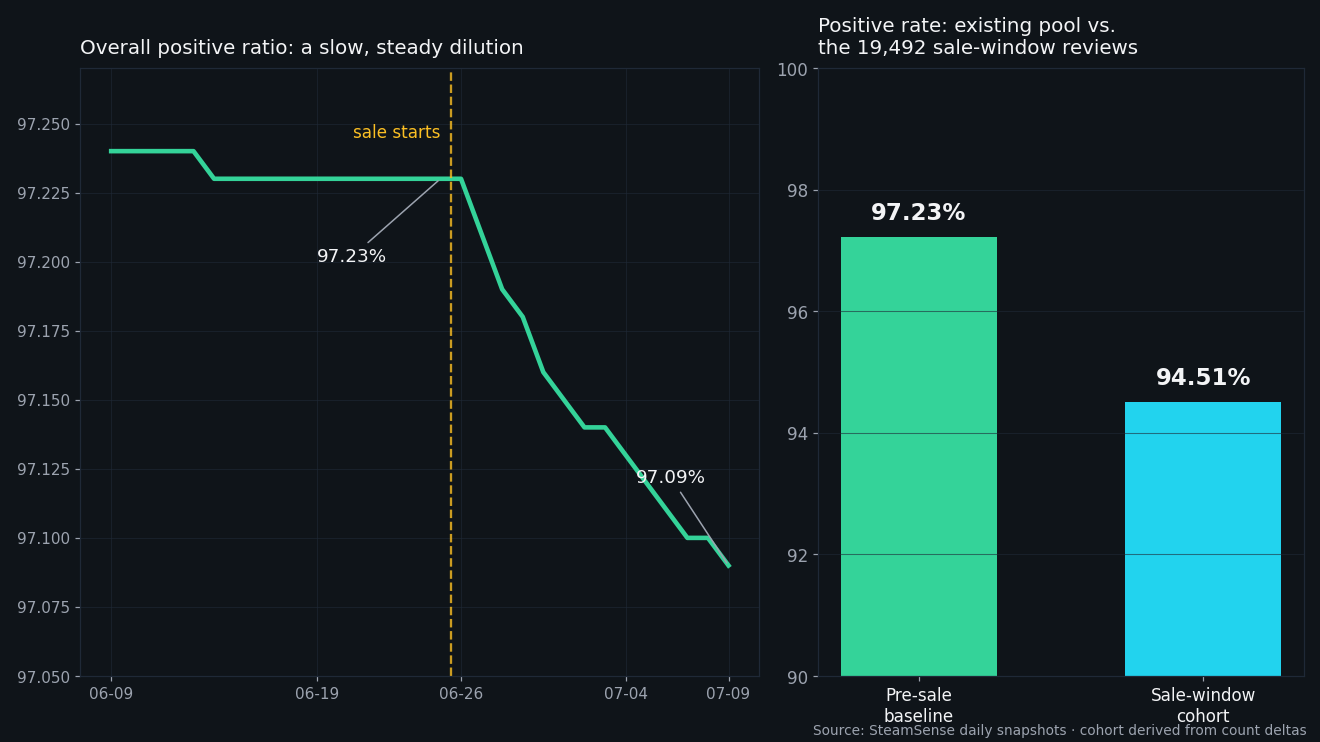
A 2.7-point gap won't change the game's "Overwhelmingly Positive" badge. But it's a clean, measurable signature of something developers debate constantly: deep-discount buyers are a different audience. People who paid $14.99 over the years were, disproportionately, people who already knew they wanted Isaac. The $1.49 crowd includes impulse buyers, curiosity buyers, "it's cheaper than a coffee" buyers — people with no prior attachment, some of whom bounce off one of the most mechanically dense roguelikes ever made.
What the data doesn't support is the scarier version of that claim — that deep discounts invite review-score damage. Isaac's discount cohort still reviews at 94.5% positive, a rate most games never touch at any price. The dilution is real, measurable, and completely harmless: nineteen thousand new reviews moved a third of a million existing ones by 0.14 points. For a game with a deep review moat, a 90% discount bought its biggest audience ever at a rating cost indistinguishable from zero.
Why it matters
For developers weighing a steep sale, this is about as clean a natural experiment as the public data offers, and both halves of it are reassuring: the demand response was enormous and lasted the full length of the sale, and the score impact was measurable only with a microscope. The old fear — that bargain-bin buyers will tank your rating — shows up in the data as a 2.7-point cohort difference diluted across a review pool eighteen times its size.
The general lesson is about reading review counts, though. A game's overall score is an average over its entire history, and averages hide cohorts. Two games can both show "97% positive" while one is coasting on 2015 goodwill and the other is winning over new buyers this week. The only way to tell them apart is to watch the dailies — which is, not coincidentally, what we do.
A note on method
Numbers come from SteamSense's daily snapshots (03:00 UTC) of The Binding of Isaac: Rebirth's public Steam review totals, June 9 – July 9, 2026. The sale-window cohort's positive rate is derived by differencing positive counts between snapshots; because Steam publishes ratios rounded to two decimals, we report the cohort rate with an uncertainty band (94.3–94.7%). Baseline (102/day) is the June 9–25 average. The 14.5x figure compares the June 27 – July 9 average (1,471/day) to that baseline, excluding the partial first sale day. Concurrent-player figures are from public trackers as reported by PC Gamer. Sale dates per Valve: June 25 – July 9, 2026, 10am Pacific. Full methodology: How we track Steam reviews.
FAQ
Why is The Binding of Isaac suddenly popular again in 2026? The Steam Summer Sale (June 25 – July 9, 2026) discounted it 90% to $1.49, its lowest price ever. The game hit an all-time concurrent player peak of 147,401 on July 3 — twelve years after release — and gained reviews at 14.5x its normal rate throughout the sale.
Do Steam sales hurt a game's review score? Isaac's data suggests barely: its sale-window buyers reviewed 94.5% positive versus a 97.2% historical baseline, moving the overall score just 0.14 points (97.23% → 97.09%). Discount cohorts measurably differ, but for a well-reviewed game the effect on the displayed score is negligible.
What is The Binding of Isaac: Rebirth's Steam rating? As of July 9, 2026: 97.09% positive across 379,302 reviews — "Overwhelmingly Positive."
Data: SteamSense daily snapshots, June 9 – July 9, 2026. Track the post-sale cliff with us at steamsense.app/game/250900.